

MOUSE: P.I. For Hire works as more than a retro gimmick because its violence is built into the language of the image. Fumi Games and PlaySide Studios released the black-and-white first-person shooter on April 16, 2026, after positioning it as a jazz-fueled detective story about Jack Pepper, a private investigator voiced by Troy Baker. The hook is obvious at a glance: 1930s rubber-hose animation, noir crime atmosphere, and high-speed gunplay in one stylized package. The reason it holds attention is stranger and more useful for film-noir readers. The old cartoon body, with its elastic limbs, impossible impacts, and musical rhythm, gives the game a visual grammar where violence can be extreme without becoming realistic gore.
Why Rubber-Hose Animation Makes Violence Feel Stylized, Not Realistic
Rubber-hose animation was built around exaggeration. Arms bend like cables, bodies snap back after impact, faces stretch into impossible expressions, and motion often lands on a musical beat. That physical language makes MOUSE: P.I. For Hire a natural fit for ultra-violent action. A realistic shooter has to manage the weight of bullets, blood, anatomy, and injury. A rubber-hose shooter can turn those same actions into a violent dance of silhouettes, smoke, splatter, props, and timing.
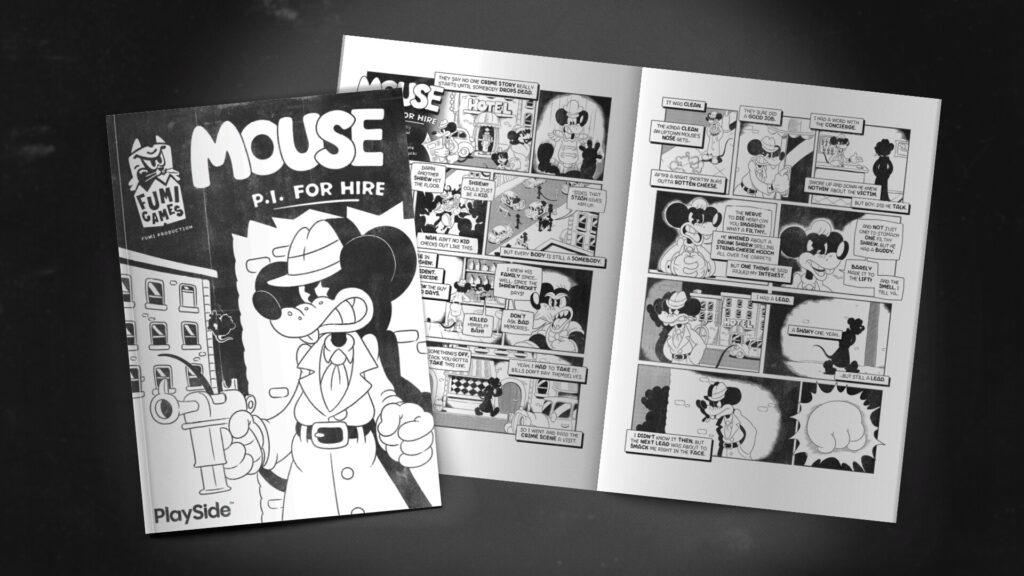
The game’s official Steam description frames that contrast clearly, presenting MOUSE as a first-person shooter that combines “hand-drawn rubber hose animation inspired by the classic cartoons of the 1930’s” with explosive FPS action on PC. That pairing matters because it changes how players read the image. The guns, fists, enemies, power-ups, and black-and-white splashes belong to a theatrical cartoon world before they belong to a literal crime scene. The result is brutal, but it is brutal in the same way slapstick can be brutal: every hit is graphic, but the body is already unreal.
That is why the style avoids the trap of simple nostalgia. Many retro projects borrow old animation as surface decoration. MOUSE: P.I. For Hire uses it as an engine. The movement is not a wrapper around the action. It explains the action. A private-eye story can move through corruption, gunfights, and moral decay without losing its comic elasticity, since the world’s visual laws already allow everything to bend, burst, and rebound.
How Noir Turns Cartoon Chaos Into A Detective Fantasy
The noir element gives the violence a frame. Jack Pepper is not a mascot thrown into random combat; he is a private investigator working through a corrupt city. PlaySide’s March 24, 2026 release update tied the launch plan to digital and physical editions, Steam pre-purchases, Xbox Play Anywhere support, and the April 16, 2026 date, but the more useful creative signal is the game’s pitch as a detective story inside a fully stylized crime world. The noir fantasy gives every exaggerated shootout a moral backdrop: streets are dirty, deals are rotten, and the hero’s job is to move through the mess with a gun in one hand and a case file in the other.
That connection fits noirwhale.com because MOUSE belongs to the same broader conversation as modern game noir. In earlier modern gaming noir analysis, the genre’s power came from inner monologue, urban shadow, and a protagonist shaped by guilt. MOUSE twists that tradition by replacing photoreal gloom with cartoon grotesque. The trench coat, jazz, corruption, femme-fatale echoes, crooked streets, and private-eye posture remain legible. The bodies around them become elastic, rodent-like, and comic.
That mixture makes the game feel closer to noir caricature than parody. Caricature is not a lesser form of noir. It can sharpen the genre by cutting away realism and leaving pure attitude: the fedora, the cigarette haze, the crooked grin, the gun barrel, the city that always seems guilty. Rubber-hose design pushes those symbols into motion. A doorway can feel suspicious. A smile can look criminal. A gunfight can become part chase sequence, part vaudeville act, part detective nightmare.
Why The Teen Rating Shows The Style Has Limits
The ESRB rating helps explain why the game can look playful and still carry harder content. The board rated MOUSE: P.I. For Hire T for Teen, citing Blood, Mild Language, and Violence. Its rating summary describes a first-person shooter based on 1920s and 1930s cartoons where players explore black-and-white levels, solve puzzles, collect clues, unlock abilities, and use weapons or powers against cartoon enemies. That source-backed rating is a useful reminder: the violence is stylized, but it is still violence.
That distinction matters for players, parents, critics, and anyone covering the game as visual culture. The rubber-hose style does not erase the content; it changes the content’s texture. Black blood-splatter effects, gunfire, melee attacks, and enemy deaths can read as comic spectacle, but the rating keeps the game from being mistaken for family cartoon entertainment. The art direction makes the violence more theatrical. The rating makes the audience boundary clear.
This is one reason the style works better here than it would in a more realistic shooter. A grim photoreal noir FPS risks flattening into another grey crime game. A pure cartoon shooter risks feeling weightless. MOUSE uses age-rating context, detective framing, and vintage animation to sit between those poles. Players are invited to enjoy impact, motion, and absurdity, but the game still signals that its world contains danger, criminal rot, and aggressive combat.
Why Public-Domain Culture Is Only Part Of The Story
The timing of MOUSE: P.I. For Hire makes the project easy to connect with wider public-domain conversation. The U.S. Copyright Office noted that a new class of 1928 works entered the public domain on January 1, 2024, including motion pictures, music, and books. That context shaped a wave of projects using early animation language, especially after the earliest version of Mickey Mouse from Steamboat Willie became available for certain uses in the United States.
The mistake would be to reduce MOUSE to a public-domain stunt. The game is not interesting only because 1920s cartoon imagery became culturally available again. It is interesting because Fumi Games and PlaySide built a new noir action identity from that older visual grammar. The difference matters. Reusing a recognizable public-domain mood can get attention; building a complete playable world demands animation discipline, combat readability, sound design, level structure, and tonal control.
That is where MOUSE separates itself from cheap shock projects. The official launch trailer presents the game through combat, noir-fueled detective storytelling, cartoon environments, original jazz, and a full arsenal of weapons and power-ups. The project’s identity depends on synthesis. It needs the audience to understand the old cartoon reference, then accept that reference as a vehicle for modern action. The best version of that approach does not ask players to laugh only at the contrast. It asks them to feel how naturally the contrast moves.
How Ultra-Violence Becomes Choreography
The phrase “ultra-violence” often suggests excess for its own sake. In MOUSE: P.I. For Hire, the stronger reading is choreography. The visual style makes combat readable through arcs, bursts, silhouettes, recoil, and rhythmic timing. A rubber-hose character can telegraph motion with a full-body curve. A weapon can feel less like a realistic firearm and more like a prop in a kinetic stage routine. Enemies can be threatening and ridiculous at the same time.
That duality is useful for noir. Classic private-eye stories often carry a bitter comic streak: everyone lies, every room has a secret, and the hero survives through instinct more than purity. Rubber-hose exaggeration turns that cynicism into shape. The city can feel crooked in a literal sense. Criminals can look like their vices have warped their bodies. Combat can feel like the environment has joined the joke.
The violence works because it is never only damage. It is movement, timing, sound, silhouette, and mood. That is why the black-and-white palette matters. Colorful gore would pull the viewer toward flesh. Black splatter and monochrome impact pull the viewer back toward ink. The player is not watching a wound so much as a drawing explode.
Why MOUSE Fits The Future Of Indie Visual Storytelling
MOUSE: P.I. For Hire points toward a useful path for indie games: visual identity as narrative structure. Many smaller studios cannot outspend blockbuster games on fidelity. They can outmaneuver them through a rule-bound aesthetic that shapes every part of the experience. Rubber-hose animation gives MOUSE that advantage. It makes screenshots instantly legible, trailers memorable, and combat readable as part of the story rather than a separate system.
For noir fans, the game also shows how flexible the genre has become. Noir no longer needs only rain, alleys, venetian blinds, and a weary human detective. It can survive inside a cartoon city, a first-person shooter, a jazz score, and a world of anthropomorphic criminals. The core remains the same: corruption, shadow, investigation, compromised justice, and style so strong that the surface becomes part of the moral argument.
That is why the rubber-hose approach feels like the right vehicle for ultra-violence. It gives the violence permission to be excessive without asking it to become realistic. It lets noir become absurd without losing its bite. It turns nostalgia into motion, motion into combat, and combat into a kind of black-ink performance. For players and critics, MOUSE: P.I. For Hire is not just a strange blend of cartoon and shooter. It is a reminder that old visual languages can still carry new forms of impact when a studio treats style as structure.