

he Westies arrives on MGM+ at a moment when television crime drama is moving back from empire-scale mythology toward smaller, meaner maps of power. Created by Chris Brancato and Michael Panes, the eight-episode series premieres July 12, 2026, with J.K. Simmons, Titus Welliver, Tom Brittney, Jessica Frances Dukes, Stanley Morgan, Sarah Bolger, Allen Leech, Hamish Allan-Headley, Vincent Walsh, and Hilary McCormack in the ensemble. The premise is direct: early 1980s Hell’s Kitchen, the violent Irish-American Westies gang, the Jacob Javits Convention Center construction project, pressure from the Mafia, FBI attention, and a generational split inside the crew. The larger cultural question is sharper. After decades of Gotti-shaped mob mythology, The Westies brings crime noir back to the neighborhood block, where ambition is local, loyalty is unstable, and urban redevelopment becomes another kind of threat.
Why The Westies Moves Crime Drama Back To The Block
The official MGM+ series page frames The Westies as a gritty crime drama about New York’s violent Irish gang in early 1980s Hell’s Kitchen, where the Javits Center project ignites a fight over profit, threatens the gang’s uneasy peace with the Mafia, and draws FBI heat. That summary explains why the show’s scale feels different from many modern mob dramas. The drama is not only about family hierarchy, national reach, or the spectacle of a boss becoming famous. It is about territorial pressure.
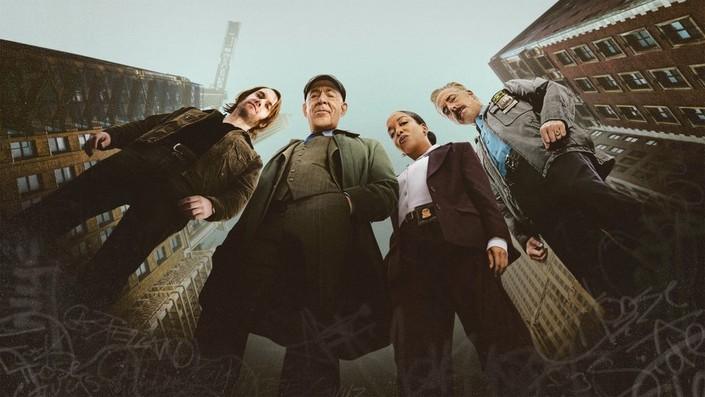
Hell’s Kitchen is not scenery in this story. It is the contested object. The streets, construction sites, bars, apartments, union corridors, and social loyalties all matter because the neighborhood is being monetized from above and defended from below. That makes The Westies a natural fit for noir analysis. Noir has always understood that crime is not detached from place. It grows through architecture, poverty, surveillance, intimidation, and opportunity.
That is where the series connects with noirwhale.com’s earlier crime movie urban design analysis, where stairwells, alleys, corridors, and glass towers act as moral pressure points. The Westies uses the same idea in television form. The city is not passive. It offers money, hides violence, exposes betrayal, and turns every development project into a test of who gets to control the future.
How The Javits Center Turns Redevelopment Into Noir Pressure
The Jacob Javits Convention Center is more than period detail. In the show’s premise, it becomes the engine of conflict. A construction project promises money, access, and influence. For a neighborhood crime crew, that kind of project is not only a building. It is a claim on labor, contracts, intimidation, and future territory. For law enforcement, it becomes a place where old street rackets meet larger public consequences. For the Mafia, it becomes an opening to pressure a smaller organization that still knows the streets better.
Amazon MGM Studios announced the series order on March 18, 2025, describing The Westies as an original crime drama from creator and executive producer Chris Brancato, with Michael Panes executive producing. That official series order announcement positioned the show inside MGM+’s existing relationship with Brancato, whose crime-drama credits include Godfather of Harlem and Hotel Cocaine. The pattern is useful: Brancato’s work often treats criminal power as a system built through politics, business, race, neighborhood memory, and violence.
In The Westies, redevelopment supplies the noir mechanism. The city changes on paper before it changes on the street. Money arrives before safety. Political language turns into pressure. A public project becomes a private war. That is where neighborhood crime can feel more fatalistic than empire crime. A national syndicate can expand. A neighborhood crew can only hold ground until the ground itself becomes more valuable than the people standing on it.
Why Post-Gotti Noir Is About Memory, Not Chronology
Calling The Westies “post-Gotti noir” does not mean the story happens after John Gotti’s fall. The series is set in early 1980s Hell’s Kitchen, and Hamish Allan-Headley is listed among the cast connected to the show’s Gotti-era crime ecosystem. The “post-Gotti” idea is about television memory. For many viewers, New York mob stories have been filtered through the public image of Gotti: the suits, the cameras, the courtroom spectacle, the “Teflon Don” mythology, and the federal case that ended with his 1992 conviction.
The FBI’s own John Gotti case history frames Gotti as the Gambino crime family boss eventually brought down in the 1990s. That public downfall shaped later mob storytelling because it turned organized crime into a media image as much as a criminal system. Gotti became a shorthand for celebrity gangster culture, federal surveillance, courtroom theater, and the end of a certain old-school public swagger.
The Westies works differently. It pulls attention away from the famous boss and back toward the edges of the power map. The Irish-American gang in Hell’s Kitchen is outnumbered, threatened, and locally rooted. That makes the drama feel less like a royal succession story and more like a pressure chamber. The question is not who becomes the most famous criminal in New York. The question is who survives when bigger families, federal agents, and younger insiders all see the same neighborhood as something to take.
Why J.K. Simmons And Titus Welliver Fit The Moral Weather
Casting matters in noir because faces carry history before dialogue begins. J.K. Simmons plays Eamon Sweeney, described in TV Insider’s preview as the ruthless head of the Irish-American crime syndicate, a figure whose brutality is masked by charm. Titus Welliver plays Glenn Keenan, an NYPD officer with deep ties to the Westies and a personal history with the people he is expected to police. That setup gives the series a classic noir fracture: law and crime are not cleanly separated; they grew up on the same block.
TV Insider’s June 26, 2026 first-look coverage of The Westies cast and premiere reports the July 12 premiere and outlines the series’ Reagan-era Manhattan setting, the Javits Center conflict, the Gambino pressure, and the FBI investigation. It also names Tom Brittney as James “Jimmy” Roarke, an ambitious younger Westies leader who looks to Sweeney as a mentor. That generational angle is central. Crime noir becomes more painful when loyalty is not only broken by enemies, but inherited badly.
Simmons and Welliver are useful for this kind of material because both actors can play authority as exhaustion. Their screen presence often carries withheld violence, moral fatigue, and the sense that every choice has already cost something. In a neighborhood crime drama, that matters more than glamour. The danger should feel intimate. A threat from a man you grew up near can be colder than a threat from a distant kingpin.
How MGM+ Is Building A Crime-Drama Identity Around Pressure
The Westies also fits MGM+’s larger crime-drama lane. The network has leaned into period crime, institutional corruption, and ensemble-driven power stories through titles such as Godfather of Harlem and Hotel Cocaine. With The Westies, the streamer appears to be working a tighter geographic register: one neighborhood, one construction project, one gang’s unstable relationship with larger Mafia power, and one law-enforcement squeeze closing in.
BroadwayWorld reported on June 17, 2026, that MGM+ released the official trailer, key art, and new images for the series, and that the eight-episode season will premiere with two episodes on July 12 before moving to weekly episodes in the U.S., the UK, Germany, Italy, Spain, the Netherlands, Belgium, Argentina, Brazil, Mexico, Chile, and Colombia. That official trailer coverage matters because release rhythm shapes reception. Two opening episodes can establish the neighborhood, the hierarchy, and the violence quickly, while weekly rollout gives the betrayal structure time to breathe.
That pacing suits noir. A binge release can flatten suspense into plot consumption. A weekly crime drama lets suspicion accumulate. Viewers sit with glances, alliances, rumors, and shifts in power. For a show about local crime, that rhythm may be useful because neighborhood stories depend on repetition. The same bar, street corner, office, church, construction fence, or police room can mean something different after each episode.
Why Neighborhood Crime Feels Different From Mafia Mythology
The Westies are useful dramatic subjects because they complicate the usual Mafia screen grammar. Italian-American organized crime has dominated much of American mob cinema and television, from The Godfather to The Sopranos to countless Gotti-adjacent retellings. Irish-American crime stories carry a different cultural charge: smaller crews, ethnic enclave tension, Catholic guilt, neighborhood decline, old loyalties, and violence tied to street-level survival rather than grand dynastic language.
That does not make the story nobler. It makes it more claustrophobic. Neighborhood crime dramas work when they refuse to romanticize proximity. Everyone knows everyone, which means everyone can be used. A childhood friendship can become leverage. A family debt can become a threat. A local business can become cover. A police officer can know too much because he grew up hearing the same names at kitchen tables and on corners.
This is where The Westies can distinguish itself from familiar mob prestige drama. The show does not need to outscale The Sopranos or out-iconize Gotti. Its stronger path is smaller and harsher: crime as neighborhood weather, redevelopment as invasion, and loyalty as a resource that runs out.
What The Westies Could Mean For Modern Noir Television
The promise of The Westies is that it brings noir back to a specific piece of urban history without treating the past as costume. The early 1980s setting carries Reagan-era money, construction ambition, organized-crime pressure, and changing New York geography. The MGM+ premise gives the story a strong conflict triangle: the Westies, the Mafia, and law enforcement. The cast gives it recognizable dramatic weight. The weekly structure gives it room for slow corruption.
The risk is familiar. A crime drama about a violent gang can become empty brutality if it loves the mythology more than the cost. The stronger noir path is to treat violence as a symptom of a neighborhood being squeezed from every side: by capital, by organized crime, by ambition, by federal scrutiny, and by men who confuse loyalty with ownership.
That is why The Westies looks like one of MGM+’s more interesting 2026 crime bets. It is not only returning to the gangster story. It is returning to the block as the place where crime drama feels most unforgiving. Post-Gotti noir does not need another untouchable celebrity boss. It needs alleys, construction fences, compromised cops, old friendships, younger rivals, and a city that changes just fast enough to make betrayal feel inevitable.