

Nirvana Noir feels built for the moment when detective fiction stops looking only at alleyways and starts looking at the universe itself. Developed by Feral Cat Den and published by Fellow Traveller, the upcoming adventure game is a follow-up to Genesis Noir, the 2021 cosmic noir title that turned the Big Bang into a gunshot and made investigation feel like jazz, grief, and creation theory colliding. The new game keeps that detective mood but splits it across two parallel realities: Black Rapture, where the Big Bang was never fired, and Constant Testament, a world of color, sin, arson, drugs, memory, and cosmic consequence. That is why Nirvana Noir belongs at the center of a larger indie-game trend. Film noir gave audiences detectives trapped inside corrupt cities. Cosmic detective games give players investigators trapped inside broken realities.
Why Nirvana Noir Turns The Detective Case Into A Cosmic Problem
The most interesting thing about Nirvana Noir is that it treats noir as a structure, not a costume. The Steam page describes it as “a noir adventure beyond time and space,” with a city of cosmic beings threatened across two parallel realities and No Man trying to uncover the mysteries of the Bigger Bang in a follow-up to the award-winning Genesis Noir. The current Steam release page lists Feral Cat Den as developer, Fellow Traveller as publisher, and the release status as “Coming soon,” which keeps the timing open rather than locking the game to an unconfirmed date.
That matters for search and reader trust. Nirvana Noir is being discussed in 2026 because its recent showcase presence gave narrative-game audiences a fresh look at its premise, not because the game has a final release date. The stronger article angle is creative rather than speculative. The game’s value comes from how it expands noir’s old investigative machinery into a surreal interactive form.
Classic noir starts with a problem that looks smaller than it is: a missing person, a dead lover, a suspicious client, a corrupt room. The detective follows the thread and discovers that the case is connected to money, betrayal, power, desire, and decay. Nirvana Noir keeps that rhythm, then enlarges the map. The case is no longer limited to a city district. The entire structure of reality has become the crime scene.
How Two Realities Replace The Classic Noir City
Noir usually needs a city. It needs streets, offices, stairwells, bars, apartments, shadowed rooms, and public spaces where private corruption can hide. Nirvana Noir keeps that urban logic but turns the city into a cosmic organism. Fellow Traveller’s official Nirvana Noir page describes a game where players talk to suspects, search for clues, use the Mind’s Eye to track open lines of investigation, and piece together evidence to unravel the mysteries of the Bigger Bang.
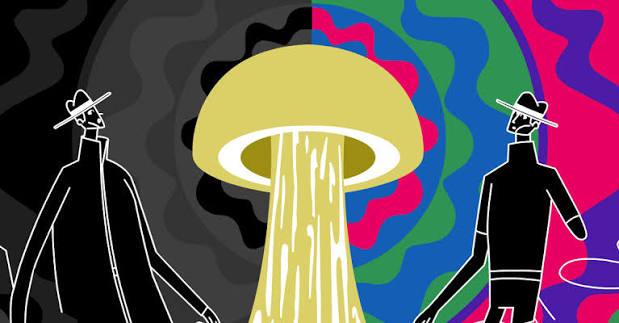
That description is direct detective language, yet the setting refuses realism. Black Rapture and Constant Testament are not just alternate visual filters. They are two answers to the same original wound. One reality is tied to absence, mechanism, and a Big Bang that never happened. The other explodes with color, temptation, music, and social disorder. In traditional noir, a detective may cross from a respectable office into a nightclub or from a wealthy estate into a back alley. In Nirvana Noir, the shift happens at the level of reality itself.
That is where the game becomes more than a sequel. It shows how indie developers can translate noir’s emotional grammar into forms film cannot easily use. A movie can cut between spaces. A game can make the player handle the difference. Searching, tracking, manipulating words, interviewing witnesses, and reconstructing events become acts of physical participation. The player does not simply watch No Man get lost in the case. The player helps produce that lost feeling.
That connects naturally with Noir Whale’s earlier cyber-noir games analysis, where digital detective stories were framed as a modern extension of noir’s old habits: curiosity, uncertainty, fragmented clues, and cities built to hide truth.
Why Story-Rich Showcase 2026 Put Indie Noir In The Right Context
Nirvana Noir gained fresh visibility through Fellow Traveller’s Story-Rich Showcase 2026, held on June 6, 2026, during the wider Summer Game Fest period. The event’s press materials described Story-Rich Showcase as a new presentation dedicated to story-rich indie games, with a debut lineup of roughly 20 to 25 games chosen on an editorial basis, with no paid or sponsored slots for participating developers. That Story-Rich Showcase press kit matters because it places Nirvana Noir inside a broader category: games where narrative design is the central attraction.
That is the right context for cosmic detective games. They do not compete with blockbuster games through scale, licensed spectacle, or endless combat systems. They compete through memory, mood, interaction, and formal risk. Nirvana Noir is not selling players a realistic crime city. It is selling a detective procedure that can survive inside abstraction.
The showcase framing helps explain why this type of noir is becoming an indie answer to film noir. Film noir was once a studio-era language of budget pressure, moral darkness, and visual ingenuity. Low light, limited sets, smoke, mirrors, shadow, voiceover, and tight framing turned constraint into style. Indie games inherit a similar problem. Smaller teams cannot outspend giant studios on realism. They can build worlds with stronger rules.
Feral Cat Den’s work fits that model. The studio’s identity is rooted in animation and interactivity rather than photorealism. Fellow Traveller’s official materials describe Feral Cat Den as a Brooklyn-based team making games, animations, web projects, VJ work, and visually tactile experiences. That background matters because Nirvana Noir reads like a moving graphic composition, not a conventional detective simulator.
Why Music Makes The Mystery Feel Alive
Noir has always depended on sound. Jazz clubs, lonely horns, city noise, footsteps, train lines, sirens, and silence all shape the detective’s world. Nirvana Noir makes music even more central. The Fellow Traveller press kit says the game features music and sound design from Skillbard, a London-based team of composers and sound designers, and that Skillbard won multiple awards for its work on Genesis Noir, including the Independent Games Festival Award for Excellence in Audio. The same Nirvana Noir press kit says the new soundtrack responds to the game with noir, neo-noir, jazz, psychedelic influences, and music-focused puzzles.
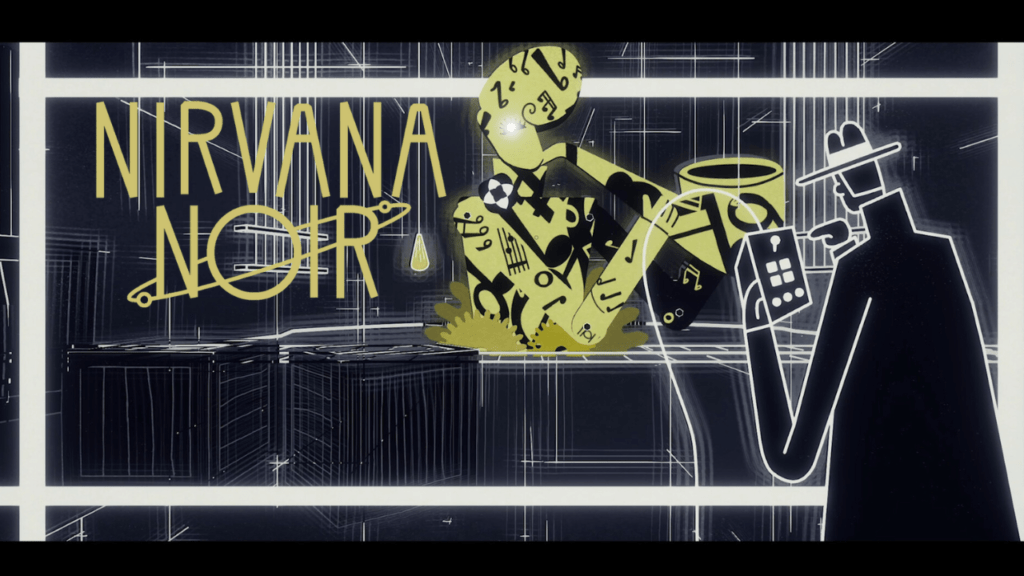
That sound design angle is not a secondary feature. It is part of the detective mechanism. If Genesis Noir treated cosmic history like a fatal jazz event, Nirvana Noir appears to treat investigation as rhythm. A clue can be visual, verbal, musical, or spatial. A city can be interrogated through sound. A puzzle can work like a score.
This is where cosmic detective games separate themselves from ordinary noir pastiche. They are not recreating smoky rooms and saxophone mood for nostalgia. They are asking what noir feels like when time, music, matter, memory, and desire are all playable. That kind of design turns the detective into a listener as much as an observer.
For players, this can change the emotional pace. A shooter solves tension through impact. A detective game solves tension through attention. Nirvana Noir seems built around that second mode. The player has to notice patterns, track unresolved lines, follow emotional clues, and make sense of a city whose evidence may be philosophical as much as physical.
How Indie Games Expand Film Noir Without Replacing It
Film noir remains powerful because cinema is unusually good at faces, shadows, silence, and fatal framing. A great noir shot can make a doorway feel guilty before anyone speaks. Games work differently. They create pressure through participation. The player must decide where to look, when to click, how to interpret an object, and which clue deserves attention.
Nirvana Noir shows why indie games are not replacing film noir but extending it. The genre’s core material remains intact: a mystery, a damaged figure, a threatened city, a past that refuses to stay buried, and a sense that truth may not heal the wound. The medium changes what the audience does with that material. Instead of receiving the detective’s confusion, the player helps organize it.
That shift is valuable for noir because the genre has always been about incomplete knowledge. A detective story works by making the audience feel that truth exists somewhere behind surfaces. Interactive noir makes that feeling procedural. The player searches, rearranges, listens, tests, and reconsiders. Mystery becomes a behavior.
The cosmic setting makes that behavior stranger. If the city itself is built from beings, myths, timelines, and cosmological damage, then every clue can carry symbolic weight. A demolished building, a legal defense, a final word, an interrogation, or a hidden phrase can become both plot detail and metaphysical evidence. That is the kind of layered meaning indie games can handle well when they commit to a strong visual and narrative rule set.
Why Cosmic Detective Games Are Becoming The Indie Noir Future
The future of noir in games may not look like a rain-slick street. It may look like a star map, a jazz score, a fractured timeline, a hand-drawn city, or a cosmic witness who remembers the wrong version of history. Nirvana Noir is useful because it refuses the narrow idea that noir must stay bound to realism. It keeps the detective’s anxiety and moves the crime into the structure of existence.
That is the indie advantage. A smaller studio can take noir’s emotional core and build a world around one bold metaphor. In Genesis Noir, the Big Bang became a gunshot. In Nirvana Noir, the aftermath splits into parallel realities where No Man has to investigate what his earlier choice made possible. That is a powerful sequel idea because it treats consequence as a universe, not a cutscene.
For Noir Whale readers, Nirvana Noir is worth watching because it sits at the intersection of several modern noir shifts: interactive investigation, cosmic dread, psychedelic art direction, jazz-driven storytelling, and indie narrative design. It does not need to imitate classic noir frame by frame. Its strength is that it understands the old genre question and asks it at a larger scale.
The detective still wants the truth. The city still hides the wound. The past still refuses to die. The difference is that the alley has opened into space, and the case may be older than time.