

The Westies arrived on MGM+ on July 12, 2026, with a two-episode premiere that pulled New York crime drama back from empire mythology and into the tighter pressure of a neighborhood fight. Co-created by Chris Brancato and Michael Panes, the eight-episode series stars J.K. Simmons, Titus Welliver, Tom Brittney, Stanley Morgan, Sarah Bolger, Jessica Frances Dukes, Hamish Allan-Headley, Vincent Walsh, Allen Leech, and Hilary McCormack. Its setting is early 1980s Hell’s Kitchen, where the Irish-American Westies gang sees the Jacob Javits Convention Center construction project as a chance to claim money and leverage while the Gambino crime family, the FBI, and internal ambition all close in. That makes the show more than another mob drama. It is neighborhood noir, where the block is the battlefield and every alliance feels temporary.
Why The Westies Works Best As Neighborhood Noir
MGM+ frames The Westies as a gritty crime drama about the Irish gang that operated in New York’s Hell’s Kitchen, with the Javits Center project creating a violent opportunity and an equally violent threat. The official MGM+ trailer announcement confirmed the July 12 premiere, the eight-episode structure, and the two-episode launch, giving the show a clear event-style entry into summer crime television.
That timing matters because the series is not built around a glamorous boss conquering a city. It is built around a crew trying to hold a neighborhood while larger forces circle. Noir works especially well at that scale. A neighborhood is small enough for everyone to know the rumors, but large enough to hide bodies, debts, secrets, and informants. The Westies do not need a global operation to feel dangerous. Their danger comes from proximity.
That is where the show’s Hell’s Kitchen setting becomes the engine. The streets are not interchangeable. They carry ethnic identity, old grudges, union pressure, family history, police attention, and the economics of redevelopment. A crime story becomes noir when the place itself seems to push people toward betrayal. The Westies understands that a construction project can be as dramatic as a murder weapon when it changes who controls the future.
How The Javits Center Turns Development Into A Crime Plot
The Jacob Javits Convention Center is the show’s best structural device because it makes urban change visible. A public construction project promises jobs, contracts, money, and prestige. For a neighborhood crime crew, it also creates shakedown routes, labor influence, extortion opportunities, and a reason for larger organized-crime groups to look harder at a smaller territory.
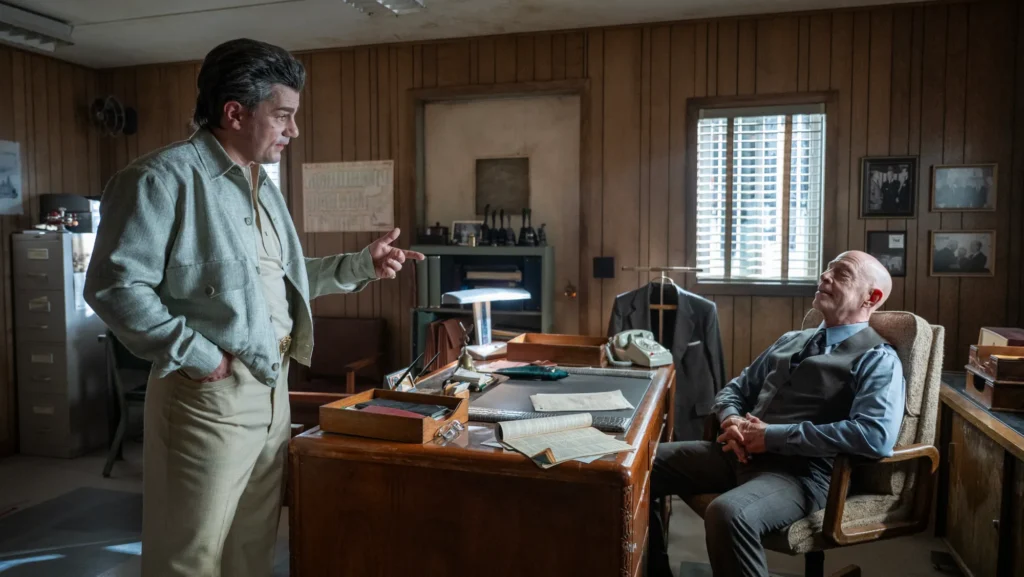
That is why The Westies feels different from a mob story built only around hierarchy. The pressure is spatial. Who controls the job site? Who gets a cut? Who talks to the Italians? Who risks drawing federal attention? Who believes the old crew can still survive when the neighborhood is becoming more valuable than the people who live there?
The New York Post’s July 13, 2026 historical feature on the real Westies linked the gang’s rise and decline to Hell’s Kitchen rackets, construction money, union pressure, murder, loan sharking, extortion, the Gambino family, and the legal fallout that eventually helped dismantle the crew. The show is fictionalized, but that history gives its premise a hard factual spine: the Westies were not mythic outsiders. They were a violent neighborhood force operating inside a changing New York.
This is why the series fits Noir Whale’s earlier urban crime cinema analysis. In both cases, architecture is not neutral. Corridors, job sites, bars, apartment stairwells, docks, and office rooms decide how betrayal moves. In The Westies, the neighborhood is not just where crime happens. It is what everyone is fighting to define.
Why J.K. Simmons Gives The Gang Boss A Tired Brutality
J.K. Simmons plays Eamon Sweeney, the Westies leader trying to keep the crew intact while the Mafia relationship, younger ambition, and federal heat all threaten the old order. The role needs more than menace. A neighborhood boss has to feel like someone who has survived long enough to know that control is mostly performance. Simmons brings that quality naturally. He can make stillness feel violent.
The reviews that followed the premiere repeatedly identified Simmons as one of the show’s strongest assets. Decider’s July 12 review described The Westies as a gritty drama about Hell’s Kitchen’s Irish mob in the 1980s and singled out the power of Simmons and Titus Welliver as morally complicated figures inside familiar mob territory. That reading is useful because the series depends on character pressure more than novelty. The Westies are not new to crime history. What matters is how the show stages their desperation.
Sweeney is compelling because his authority is already under attack. He is not building a kingdom from scratch. He is maintaining a violent arrangement that younger men may no longer respect and stronger organizations may no longer tolerate. That is pure noir aging. The old codes are not noble, but they are codes. The new order may be less disciplined, less patient, and more reckless.
Simmons’ presence gives the show a center of gravity. He looks like a man who can end a conversation without raising his voice. In neighborhood noir, that kind of power feels more frightening than spectacle because everyone understands the consequence before it happens.
How Titus Welliver Makes Law Enforcement Feel Compromised By Memory
Titus Welliver’s role gives the series another noir pressure point: law enforcement is not outside the neighborhood. It comes from somewhere, knows people, carries debts, and may have personal history with the very world it is supposed to investigate. That matters because crime drama becomes flatter when police and criminals exist in separate moral rooms.
The show’s early coverage identifies Welliver as part of the central ensemble alongside Simmons, Tom Brittney, Jessica Frances Dukes, and other key players. His presence matters because Welliver often plays authority with exhaustion and ambiguity. In a Hell’s Kitchen story, that tone is valuable. A cop or investigator tied to the neighborhood can never fully act like a stranger. Every name carries memory.
That dynamic helps The Westies avoid a simple cops-versus-gangsters frame. The FBI may be closing in, but the deeper noir tension is that the neighborhood has already mixed law, crime, family, friendship, and survival. A badge does not erase childhood geography. A case file does not remove the fact that people grew up together, drank in the same places, or heard the same rumors.
This is where neighborhood noir differs from procedural drama. The investigation is not only about evidence. It is about who can afford to speak, who has already chosen silence, and who is too entangled to tell the whole truth.
Why Tom Brittney’s Jimmy Roarke Brings Generational Threat
Tom Brittney’s Jimmy Roarke gives the show its younger-pressure line. A crime crew can survive enemies from the outside, but noir often finds sharper drama inside the succession problem. The next generation wants more, moves faster, and mistakes volatility for vision. In a neighborhood story, that conflict can turn every room into a power test.
The Westies’ alliance with the Italian Mafia, the Javits Center money, and FBI attention all make the generational split more dangerous. Young ambition does not exist in a vacuum. It arrives when the old arrangement is already unstable. If the crew reaches too far, the Mafia can punish them. If they stay too cautious, younger men can smell weakness. If they grow too visible, federal pressure increases.
That is why Jimmy Roarke matters beyond plot mechanics. He represents the crime-drama question that always follows aging power: who inherits violence, and what do they think it means? The old boss may see violence as a tool to preserve territory. The younger challenger may see it as identity, leverage, or proof of courage. Noir knows that difference can destroy a crew from inside.
Sarah Bolger’s role in the ensemble adds another layer because political ambition, family ties, and romantic proximity can change how crime decisions travel. Neighborhood noir thrives when private relationships are never truly private. A girlfriend, wife, sibling, priest, bartender, informant, or union contact can become part of the power map without ever holding a gun.
Why The Show’s Familiar Mob DNA Still Has A Useful Edge
Critics have already noted that The Westies walks close to familiar mob-TV territory. The Guardian’s July 12 review compared the series to the broader legacy of Irish-American gang drama and Italian mob storytelling, while pointing out that its best material comes from character conflict, dark humor, violence, and the tension around figures such as Sweeney, Jimmy Roarke, and John Gotti. That criticism is fair. The show is not arriving in a vacuum. Viewers bring memories of The Sopranos, Boardwalk Empire, Peaky Blinders, The Departed, and countless New York crime stories.
The question is whether familiarity hurts the show or helps it. For Noir Whale readers, the answer depends on what the series does with place. If The Westies becomes only another collection of leather jackets, bar fights, threats, and mob meetings, it risks feeling secondhand. If it keeps Hell’s Kitchen and the Javits Center at the center, the familiar elements can become useful grammar.
Noir has always reused recognizable parts: the detective, the femme fatale, the corrupt boss, the double-cross, the city at night, the room with too many shadows. Repetition is not automatically weakness. The issue is whether the parts are arranged around a living pressure. The Westies has that pressure because its story is about a neighborhood crew facing a city that is changing faster than its codes.
The best version of the show will not try to out-iconize Gotti or outscale Italian mob mythology. Its stronger path is local: a street-level crew that knows it is outnumbered, overmatched, and too brutal to disappear quietly.
How Neighborhood Noir Can Make Crime TV Feel Smaller And Harder
Modern crime television often grows too large. Every season needs a bigger conspiracy, a more famous criminal, a wider syndicate, or a deeper institutional web. The Westies suggests another route. Make the map smaller. Make the pressure closer. Let the audience feel that one bar, one construction site, one block, and one family dinner can carry enough danger.
That is why the show’s weekly structure after the two-episode premiere could work well. Neighborhood drama benefits from repetition. Viewers return to the same rooms and begin to notice who sits where, who avoids eye contact, who enters late, who leaves early, and who seems too calm. Noir depends on accumulated suspicion. A weekly release gives that suspicion room to settle.
The Westies’ real-world reputation for extreme violence gives the show danger, but danger alone is not enough. The richer noir angle is that violence is only one language inside the neighborhood. Money speaks. Silence speaks. Architecture speaks. Proximity speaks. Old loyalty speaks until it breaks.
That is the appeal of neighborhood noir on TV. It lets crime feel both personal and systemic. Every betrayal has a face, but every face belongs to a larger map of pressure. The viewer can understand the whole world without needing a crime-family chart that covers half the country.
Why The Westies Could Matter For MGM+ Crime Drama
MGM+ has been building a recognizable lane around crime dramas that mix period settings, neighborhood power, and morally compromised authority. Godfather of Harlem turned Bumpy Johnson’s return into a legacy-crime saga. Hotel Cocaine used Miami nightlife, law enforcement, and drug-era tension. The Westies brings that interest back to New York through Irish-American gang history and Hell’s Kitchen redevelopment pressure.
That makes the show strategically useful for the platform. MGM+ does not need The Westies to be the biggest crime drama on television. It needs it to be specific enough that crime-TV viewers recognize the brand: period danger, strong actors, political or economic pressure, and a city that shapes the plot.
For noirwhale.com readers, the value is even clearer. The Westies brings noir back to the neighborhood, where crime is not abstract empire but local weather. People know which doors not to knock on. They know who drinks where. They know who can make trouble disappear and who can make a person disappear with it.
The show’s early success will depend on whether it treats Hell’s Kitchen as more than a backdrop. If the final episodes keep the Javits Center, the Gambino relationship, the FBI investigation, and the generational split tied to place, The Westies can become one of 2026’s sharper examples of televised neighborhood noir. The crime is not only what the gang does. It is what the changing city allows, rewards, and eventually exposes.