

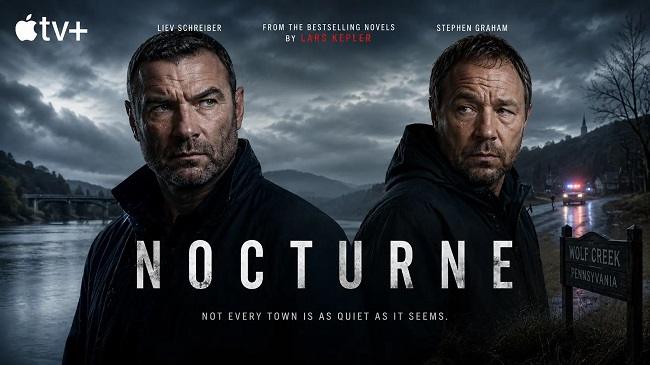
Nocturne gives Apple TV a crime drama built from one of the most durable noir engines: a detective who leaves the city for quiet, only to discover that violence has followed him into the place he hoped would save him. Apple unveiled the first look at the 10-episode series on July 7, 2026, confirming that it will premiere globally on October 30, 2026, with two episodes at launch and weekly episodes through December 25. Based on Lars Kepler’s internationally bestselling crime novels Lazarus and The Sandman, the series stars Liev Schreiber, Zazie Beetz, and Stephen Graham in a story that moves Nordic crime fiction into a Pennsylvania setting. That is why Nocturne matters for Noir Whale: it is not just another serial-killer thriller. It shows how international crime fiction is being rebuilt for streaming noir, where geography changes but dread survives.
Why Nocturne Turns Nordic Crime Fiction Into American Noir
Apple’s official Nocturne announcement describes the series as a new crime drama based on Lazarus and The Sandman by Lars Kepler, the pen name of Swedish authors Alexandra Coelho Ahndoril and Alexander Ahndoril. That literary origin matters. Kepler’s novels belong to the Nordic crime tradition, where the detective story becomes a pressure system for trauma, institutional fear, family damage, and the lingering consequences of violence.
Nocturne adapts that tradition into an American setting. Apple’s synopsis centers on Jonah Lynn, played by Liev Schreiber, an ex-soldier turned homicide detective who leaves the tough streets of Philadelphia for a small Western Pennsylvania town, hoping for quiet. That premise immediately turns relocation into noir irony. The detective thinks distance can solve what work, violence, and memory have done to him. Noir almost always punishes that belief.
The threat is Jurek Walter, played by Stephen Graham, a diabolically cunning serial killer whose reach endangers Jonah’s town and family. The series also stars Zazie Beetz as FBI Agent Saga Bauer, Jonah’s estranged daughter, who is sent to track the killer’s last victim. This gives the show a double structure: the father protects home while the daughter follows the case. Crime becomes both external pursuit and family rupture.
That is where Nocturne can become streaming noir rather than only crime adaptation. The case is not contained by jurisdiction. It invades family, town, memory, and the fragile fantasy of starting over.
How Liev Schreiber’s Jonah Lynn Fits The Damaged Detective Tradition
Liev Schreiber is an important choice for Jonah Lynn because his screen presence carries fatigue without losing authority. A retired or relocated detective can become a cliché if the character is only gruff. Jonah needs to feel like someone who has seen too much but still cannot ignore danger. Apple identifies him as an ex-soldier turned homicide detective, which gives the character two histories of violence before the story even begins.
That backstory is useful for noir. The damaged detective is not compelling because he suffers. He is compelling because his damage affects how he reads the world. A quieter town does not look innocent to him. A small change in behavior, a missing person, a strange silence, or a threat to family may register faster because his nervous system has been trained by earlier danger.
Noir often begins when the protagonist tries to step outside the machine. Jonah leaving Philadelphia for Western Pennsylvania is that attempt. He wants a quieter life, which means he still believes place can rescue him from memory. But a serial-killer story built from Lars Kepler’s fiction is unlikely to let place remain comforting for long.
This connects naturally with Noir Whale’s earlier Nordic noir streaming analysis, where the modern detective is less a heroic solver than a figure built to endure pressure. Jonah’s move from city homicide work to small-town danger gives that same structure an American shape.
Why Zazie Beetz’s Saga Bauer Gives The Series A Family-Noir Edge
Zazie Beetz’s role as FBI Agent Saga Bauer may be the show’s most important adaptation choice. In the source tradition, Saga Bauer is one of Lars Kepler’s signature investigative figures. In Apple’s version, she is Jonah Lynn’s estranged daughter, which reshapes the investigative material around family distance, professional duty, and inherited damage.
That change matters because streaming noir often works best when the case has a private wound inside it. Saga is not simply an FBI agent assigned to a dangerous killer. She is the daughter of the man whose town and family are under threat. That gives every investigative decision emotional friction. If she finds the killer’s last victim, she may also have to confront what her father’s life did to their relationship.
Family noir is especially effective because it turns intimacy into evidence. Estrangement becomes part of the mystery’s emotional map. What does Saga know about Jonah? What does she refuse to forgive? What part of his past did she inherit without choosing it? A serial killer can move the plot forward, but the father-daughter fracture can give the series its deeper tension.
Beetz also brings a different kind of energy to the detective role. She can play intelligence without stiffness and guarded emotion without making a character feel closed off. In a series that may carry heavy violence and procedural urgency, Saga’s perspective could keep Nocturne from becoming only Jonah’s haunted-retirement story. It gives the investigation another pulse.
How Stephen Graham’s Jurek Walter Could Make Evil Feel Procedural
Stephen Graham as Jurek Walter is the casting that gives Nocturne its most immediate menace. Graham is effective because he can make volatility feel lived-in rather than theatrical. Apple describes Walter as diabolically cunning, and the series’ source material gives him a reputation as one of Lars Kepler’s most frightening criminal figures.
The danger with serial-killer television is repetition. A clever killer taunts investigators. Victims vanish. Clues arrive in controlled doses. Detectives race the clock. Audiences have seen that pattern often enough that a new series needs more than intensity. It needs a distinctive moral and psychological frame.
Nocturne has a path if it treats Walter not as a supervillain but as a system of pressure. The most frightening killers in noir-adjacent crime fiction are not scary only because they kill. They are scary because they understand how institutions, families, police habits, and emotional vulnerabilities can be manipulated. A serial killer becomes noir when he exposes the hidden weakness in the world built to contain him.
That is why the pairing of Jonah and Saga matters. Walter’s threat is not only physical. It can attack trust. It can turn father and daughter into parallel investigators separated by memory. It can make a small Pennsylvania town feel like a stage where every safe assumption has been rehearsed by someone else.
Why Western Pennsylvania Changes The Meaning Of The Story
Moving a Nordic crime structure into Western Pennsylvania is not a small cosmetic shift. It changes weather, class, geography, law-enforcement texture, and community memory. Philadelphia represents urban homicide exhaustion in Apple’s premise, while the small town represents the dream of withdrawal. Western Pennsylvania can carry industrial history, wooded isolation, old houses, local suspicion, and the emotional claustrophobia of a place where privacy is never complete.
That is fertile ground for noir. A big city hides crime through scale. A small town hides crime through familiarity. People know each other, or believe they do. That belief can become dangerous. A detective who moves into a quieter community may discover that quiet is not the absence of violence. It is the sound violence makes when everyone has agreed not to hear it.
The title Nocturne also changes the tone. A nocturne is a night piece, and that musical idea gives the series a useful noir metaphor. Night is not only darkness. It is mood, repetition, loneliness, and hidden movement. The weekly release from October 30 through December 25 positions the series as a late-fall crime drama, arriving when its darkness can become part of the viewing season.
Streaming noir depends on that kind of atmosphere. A film can deliver a single descent. A 10-episode series needs a rhythm of return. Each week can tighten the relationship between town, family, killer, and memory.
How Apple TV Is Turning Crime Fiction Into Prestige Streaming Noir
Apple TV’s crime slate has increasingly leaned toward literary sources, star-driven psychology, and genre tension rather than traditional network procedural design. Nocturne fits beside Apple projects such as Sugar, Lucky, and Guilty Creatures because it uses crime as a way to examine identity, family, memory, and moral exhaustion.
The production team reinforces that ambition. Apple identifies Nocturne as created for television by BAFTA Award winner Rowan Joffé, who writes and executive produces, and developed for television, written, executive produced, and showrun by John Hlavin. Schreiber also executive produces, alongside a team that includes Shelley Browning, Douglas Schwalbe, Joseph Incaprera, Henrik Bastin, Melissa Aouate, Lars Kepler’s Alexander Ahndoril and Alexandra Coelho Ahndoril, Russell Rothberg, and John Calley.
Those credits matter because Nocturne is not only borrowing a bestselling title. It is translating a literary crime world into a long-form streaming machine. The adaptation has to balance source-reader expectations with U.S. setting changes, character restructuring, and weekly television pacing.
That is the modern streaming-noir challenge. A platform does not simply buy plot. It buys atmosphere. It buys recognizable literary credibility. It buys a mood that can hold viewers across 10 episodes. With Nocturne, Apple is betting that Lars Kepler’s serial-killer dread can survive a transatlantic shift because the emotional machinery is portable: damaged investigators, family fracture, predatory intelligence, and the fear that no place is truly outside the case.
Why Lars Kepler’s Crime Novels Travel So Well
Lars Kepler’s work travels because it is built on primal suspense but supported by psychological structure. The novels often use procedural momentum, extreme stakes, and damaged investigators, yet the deeper attraction is emotional persistence. Characters carry the past into every scene. Violence is not an isolated event; it produces aftershocks.
That makes the books adaptable to streaming. A long-form series needs more than one mystery. It needs pressure that can renew itself. Nocturne has that through Jonah’s past, Saga’s estrangement, Walter’s ongoing threat, the missing final victim, and the town under attack. Each element can produce a different kind of episode: pursuit, family confrontation, small-town suspicion, flashback, procedural discovery, psychological showdown.
The best version of the show will not simply Americanize Nordic noir by changing names and locations. It will ask what remains of Nordic crime fiction when transplanted into U.S. geography. The answer should be mood and structure, not imitation. Snow is not required. Bleakness is not tied to latitude. Noir emerges whenever institutions fail to protect people from the consequences of secrets.
If Nocturne understands that, it can become a true streaming-noir adaptation rather than a crime import wearing new clothes.
What Nocturne Could Add To The Serial-Killer Thriller
The serial-killer thriller is one of television’s most overused forms, but Nocturne has several ways to make it feel newly relevant. First, it has a family structure that places Jonah and Saga on opposite ends of the same wound. Second, it has a small-town relocation premise that makes safety feel temporary. Third, it has a literary source with international recognition. Fourth, it has three central actors who can carry psychological weight without needing constant exposition.
The show’s greatest risk is excess. If Walter becomes too operatic, the noir turns into villain spectacle. If Jonah becomes too saintly, the damaged-detective premise loses its bite. If Saga becomes only an FBI function, the father-daughter tension becomes decoration. The strongest version will keep every character morally and emotionally pressured.
That is why Nocturne is worth watching for Noir Whale readers. It sits at the intersection of Nordic crime fiction, American small-town dread, serial-killer horror, and family noir. It does not need to reinvent the detective thriller from scratch. It needs to make the familiar form feel haunted again.
If Apple TV succeeds, Nocturne could show why Lars Kepler’s novels are built for modern streaming: they understand that the case is never only a case. It is a contagion. It enters homes, families, towns, memories, and careers. The detective may move away from the city, but noir follows because noir was never only in the city. It was in the damage he carried with him.
Use up and down arrow keys to resize the meta box pane.