

Star Trek: Shadow Frontier is one of the strangest franchise pivots announced in 2026 because it takes a universe built on curiosity, diplomacy, and cooperative exploration and hands it to Bloober Team, the Polish studio associated with psychological horror, fractured perception, and haunted interiors. Paramount Games and Bloober Team revealed the game during IGN Live in June 2026, with a 2027 launch planned for PlayStation 5, Xbox Series X|S, and PC, while Gematsu also reported Switch 2 as a platform. The story centers on Ro Laren, the Bajoran former Starfleet officer voiced by Michelle Forbes, after she crash-lands on an uncharted planet that has become a spaceship graveyard. The question is not only whether Star Trek can work as horror. It is whether space exploration can become noir when discovery itself starts acting like a trap.
Why Star Trek Horror Works Best When Exploration Becomes Suspicion
The official Bloober Team announcement describes Star Trek: Shadow Frontier as a sci-fi psychological thriller set on a mysterious, uncharted planet, with Ro Laren crash-landing after answering a distress call. That setup is pure Star Trek on the surface. A signal is received. A frontier space is entered. A character moves toward the unknown because duty demands investigation.
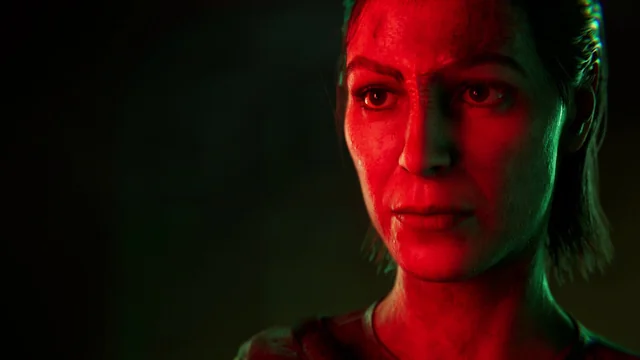
The noir turn comes from what the planet does to that duty. The same announcement says the planet is a spaceship graveyard where nothing is as it seems, with twisted creatures, a hostile ecosystem, and an entity that seeks to envelop Ro’s body and mind. Exploration no longer guarantees enlightenment. It becomes exposure. The more Ro sees, the less secure reality becomes.
That is where Shadow Frontier could become noir horror instead of only licensed sci-fi horror. Noir begins when investigation reveals that the system itself is compromised. The detective thinks the case is external, then discovers that the city, the institution, the client, or even the self cannot be trusted. Star Trek usually treats unknown worlds as moral and scientific tests. Bloober Team’s version appears to treat the unknown world as an interrogator.
For noirwhale.com readers, that is a useful shift. The “frontier” in the title is not just a place beyond the map. It is a psychological border. Once Ro crosses it, the familiar tools of Starfleet logic may not be enough.
How Ro Laren Makes The Story Darker Than A Standard Starfleet Mission
Ro Laren is a smart protagonist choice because she already carries friction inside the Star Trek universe. Introduced in Star Trek: The Next Generation and later returned in Star Trek: Picard, Ro is tied to Bajoran trauma, Starfleet discipline, resistance politics, betrayal, survival, and the burden of personal history. She is not a blank officer dropped into horror. She is a character whose past can plausibly become part of the threat.
The Steam release page describes the game as a story-driven action-adventure that places players inside the fractured mind of former Lieutenant Ro Laren, voiced by Michelle Forbes, as she tries to rescue an old friend and moves through survival and self-discovery. That phrase, “fractured mind,” matters. It suggests the horror is not only outside her. It is operating through memory, identity, guilt, and perception.
That makes the game different from a conventional survival story. Ro is not simply trying to escape a hostile planet. She may be trying to survive what the planet does with her history. This is where psychological horror and noir overlap. Both genres understand that the past is never only backstory. It returns as pressure. It distorts decisions, controls what a person sees, and turns self-knowledge into danger.
Bloober Team’s involvement sharpens that expectation. The studio’s association with Silent Hill 2 and Layers of Fear gives Shadow Frontier an immediate psychological-horror frame. The risk is tonal mismatch. The opportunity is that Ro is one of the few Star Trek characters whose moral damage can support that frame without feeling artificially darkened.
Why A Spaceship Graveyard Is A Noir City In Disguise
Noir usually needs a city, but it does not always need streets. It needs a system of compromised spaces: offices, hotels, alleys, police rooms, apartments, nightclubs, elevators, and places where people vanish behind closed doors. A spaceship graveyard can work the same way if the design treats wreckage as social memory.
A graveyard of ships is not only debris. It is a record of failed missions, broken crews, unanswered distress calls, bad decisions, and abandoned hopes. In noir terms, every wreck is a room with a secret. The planet becomes a city made of corpses. Corridors replace alleyways. Broken hulls replace tenements. Starfleet technology becomes both evidence and bait.
Gematsu’s announcement coverage quotes the game overview describing a planet-wide entity that overtakes the landscape, weaponizes it, spawns creatures, and threatens Ro’s consciousness. It also notes exploration, puzzles, combat, cinematic set pieces, the Tricorder for scanning and analysis, and the Phaser for puzzles and enemies. Those tools are important because they let the game keep Star Trek grammar while changing its emotional meaning.
A Tricorder normally promises clarity. Scan the anomaly, identify the energy field, classify the organism, solve the scientific problem. In noir horror, scanning could become an act of dread. The tool may tell Ro what something is without explaining why it should exist. A Phaser normally suggests defense. In a psychological thriller, violence may buy time without restoring certainty.
That is why Shadow Frontier can connect with Noir Whale’s earlier meta-noir gaming analysis, where horror and investigation become tangled through unstable perception. Both ideas depend on the same noir principle: the deeper the protagonist investigates, the less solid the world becomes.
How Bloober Team Could Shift Star Trek From Wonder To Paranoia
The most delicate task for Shadow Frontier is preserving enough Star Trek optimism to make the horror feel like a violation, not a replacement. If the game becomes only a dark corridor thriller, it risks flattening the franchise into a generic haunted planet. The stronger path is to begin from recognizable Star Trek values—curiosity, rescue, ethical duty, observation, courage—and make each one unstable under pressure.
Paramount Games Studio senior vice president Shawn Kittelsen said the partnership needed a studio that could honor Star Trek’s legacy while pushing it forward, according to Gematsu’s report. Bloober Team CEO Piotr Babieno framed the project as a combination of the studio’s sci-fi fandom and its “dark, psychological thriller” strengths. Those official comments matter because they identify the tension the game must manage: respect for the franchise, but not safety from fear.
Noir horror would be the correct bridge. Noir does not require nihilism. It requires moral pressure. A noir protagonist can still want to do the right thing while suspecting the world has made that impossible. That is a useful fit for Star Trek. Ro can remain driven by duty and rescue, yet the planet can keep attacking the very tools she uses to understand duty and rescue.
Paranoia in this context should not mean cheap betrayal in every scene. It should mean procedural doubt. Is the distress call real? Are the survivors trustworthy? Is Ro remembering correctly? Is the planet studying her? Are Starfleet instincts helping or endangering her? Those questions would let Shadow Frontier make exploration frightening without mocking exploration itself.
Why Noir Horror Could Help Star Trek Games Find A New Shape
Star Trek games have often struggled with the same problem as many licensed science-fiction games: the franchise is broad, but interactive design demands focus. Starship command, diplomacy, tactical combat, exploration, away missions, puzzle-solving, and character drama can all belong to Star Trek, yet few games can make all of them equally strong. Shadow Frontier appears to narrow the frame around one character, one hostile planet, one psychological threat, and a set of practical tools.
That could be an advantage. A tighter frame allows the game to turn franchise identity into atmosphere rather than checklist. Ro’s crash landing creates isolation. The distress call creates a noir case. The planet creates a hostile city-substitute. The Tricorder creates investigation. The Phaser creates survival pressure. The entity creates cosmic dread. The spaceship graveyard creates history.
PC Gamer’s recent reaction to the announcement captured the debate around this choice, arguing that Star Trek horror is plausible but risky when the franchise’s spirit is often team-based and hopeful. That skepticism is useful because it names the design challenge. Shadow Frontier cannot simply borrow the franchise name and ignore the values underneath it. It has to show what happens when those values are tested in conditions where the crew, bridge, and institutional comfort are gone.
If Bloober Team succeeds, the game could open a lane for franchise noir: not grimdark branding, but focused stories where a familiar universe is made strange through investigation, isolation, and moral uncertainty.
What Players Should Watch Before The 2027 Launch
The key question before release is how Star Trek: Shadow Frontier balances horror mechanics with investigative play. The official and trade descriptions mention exploration, puzzles, combat, cinematic set pieces, scanning, analysis, survival, and smart decision-making. That suggests a hybrid experience rather than a pure action game. For noir horror, the balance matters. Too much combat could make the planet feel like a monster arena. Too little agency could turn the experience into a guided mood piece.
Players should watch for how Bloober Team handles Ro’s memories, the old friend she is trying to rescue, the planet-wide entity, and the difference between environmental threat and psychological threat. The strongest version of Shadow Frontier would make the player feel that every scan, corridor, wreck, and survival choice is also part of an investigation into Ro’s own past.
That is why the project is worth following from a noir perspective. The game’s premise turns the Starfleet mission into a detective case where the crime scene is a planet, the suspect may be an ecosystem, and the witness may be the protagonist’s own damaged memory. Space exploration becomes noir horror when the unknown does not wait to be cataloged. It watches back.
For noirwhale.com readers, Shadow Frontier could become one of the more revealing 2027 genre experiments. If it honors Star Trek’s curiosity while letting Bloober Team make that curiosity dangerous, it may show how franchise science fiction can move beyond spectacle into dread, perception, and haunted investigation. The final test will be whether the game uses darkness to deepen the frontier, not merely to dim it.