

Thief: The Dark Project Remastered matters because it revives a game that understood darkness as more than mood. Atari, Nightdive Studios, and Eidos-Montréal announced the remaster in June 2026, bringing Looking Glass Studios’ 1998 stealth classic back for modern platforms with a winter 2026 release window. The project includes Thief: The Dark Project and the additional missions, content, and updates from the 1999 Thief Gold re-release, rebuilt through Nightdive’s KEX Engine. That technical revival is useful, but the deeper reason Thief still matters to noir is simpler: it treats shadow as behavior. Shooters often use darkness as atmosphere before gunfire breaks it. Thief makes darkness the place where thought happens.
Why Thief Still Feels Like Shadow Noir
The official Atari page for Thief: The Dark Project Remastered calls the original the first PC stealth game to use light and sound as game mechanics, letting players hide, sneak, listen, and avoid direct confrontation instead of attacking head-on. That is the core reason the game remains noir-adjacent after more than 25 years. It does not only place a criminal in a dark city. It makes the player depend on darkness to survive.
Noir has always cared about what cannot be seen clearly. A half-lit doorway, a streetlamp, a window blind, or a patch of darkness can decide who has power in a scene. Thief turns that visual principle into a playable rule. Garrett is not a heroic marksman clearing rooms. He is an intruder reading surfaces: how bright a corridor is, how loudly a floor reacts, how far a guard can hear, how quickly a body can be hidden, and whether one more step will expose him.
That is why the game still feels closer to noir than many shooters that borrow noir dialogue or rain-soaked alleys. Noir is not only an aesthetic. It is a condition of suspicion. Thief forces players to live inside that condition. The city is not a shooting gallery. It is a listening device.
How Light And Sound Replace Gunfire As Narrative Pressure
Shooters often create tension through visibility. The player sees enemies, aims, fires, reloads, and moves forward. Thief reverses that relationship. Visibility is the threat. Sound is evidence. Light is danger. Progress depends on restraint. The remaster’s official description emphasizes that advanced NPCs can hear, speak, sound alarms, and react if the player makes a wrong move. That design turns every space into a moral and tactical puzzle.
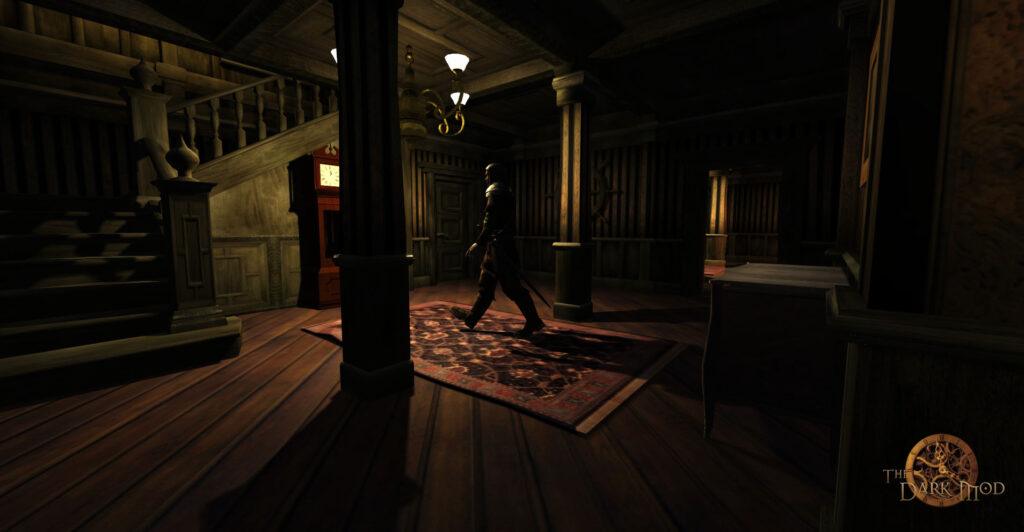
This is where the game’s noir structure becomes clearest. A shooter can make the player feel powerful in a dark room. Thief makes the player feel implicated. Garrett enters private spaces, steals valuables, overhears conversations, and survives by knowing more than others know he knows. That is not the fantasy of open combat. It is the fantasy of criminal perception.
The game’s design also makes architecture central. Corridors, courtyards, manors, catacombs, rooftops, and hidden passages become systems of exposure and concealment. That connects naturally with Noir Whale’s earlier video game noir analysis, where lighting, rain, streets, and interactive movement shaped how games translated film-noir language into playable space.
Thief goes even further. It does not simply show noir spaces. It asks the player to interpret them. A bright tile, a metal floor, a torch, a guard route, or a locked door can carry as much narrative pressure as a line of dialogue.
Why Garrett Is A Better Noir Figure Than A Power-Fantasy Hero
Garrett works because he is not designed as a savior. He is a thief, an observer, a cynic, and an opportunist who survives by staying outside the world’s official moral categories. That puts him closer to the classic noir antihero than to the modern action protagonist. He is competent, but not clean. He has a code, but not a heroic mission. He moves through corruption without pretending he can purify it.
That is why Thief still feels tonally sharper than many games that try to become dark through violence. Garrett’s darkness is not only visual. It is social. He exists at the edge of class, religion, industry, occult power, and civic order. He steals from the rich, avoids the guards, listens to institutions from the outside, and treats the city as something to be survived rather than saved.
The remaster can reintroduce that figure to players who know stealth through smoother modern systems but may not know how strange the original felt in 1998. At a time when many first-person games rewarded aggression, Thief asked players to move slowly, listen closely, and accept that the best outcome was often leaving no trace.
That is noir logic. The most important action is not always the loudest one. The decisive moment may be waiting in shadow while someone else reveals the truth.
How The Remaster Can Preserve A City Built From Fear
Atari’s current product page states that the remaster combines the original Thief: The Dark Project with the Thief Gold expansion content and uses Nightdive’s KEX Engine. The practical expectation is clearer visuals, modern platform support, and renewed accessibility for players who may not want to wrestle with the original PC release. The artistic challenge is harder: Thief must still feel dangerous.
Old stealth games often depended on roughness. Limited lighting, angular spaces, stark audio cues, and uncomfortable movement could make the world feel hostile. A remaster can improve clarity without sanding away dread, but it has to be careful. Too much polish can make a haunted city feel like a museum exhibit. Too little technical care can leave new players fighting the interface rather than reading the shadows.
Nightdive’s involvement is encouraging because the studio has built its reputation around reviving older games while preserving their identity. PC Gamer reported that Nightdive brought back Daniel Thron, an original artist from the 1998 game, to help revamp cutscenes while preserving the distinctive visual character of the original presentation. That detail matters because Thief is remembered not only for level design, but for its briefing videos, parchment-like motion graphics, voice atmosphere, and strange medieval-industrial mood.
The remaster’s best path is not to make Thief look like a new blockbuster. It is to make the old fear readable again.
Why Stealth Carries Noir Better Than Constant Combat
Shooters can be noir. Max Payne proved that inner monologue, grief, snow, and gunplay could become playable hardboiled tragedy. Yet stealth has a special relationship with noir because it makes the player inhabit uncertainty. A shooter tends to resolve ambiguity through force. A stealth game makes ambiguity last.
In Thief, the player’s strongest weapon is not a gun. It is timing. The game asks whether a room can be crossed, whether a guard can be avoided, whether a noise was too loud, whether a locked door is worth the risk, whether a purse should be taken, whether a body can be moved before another patrol turns the corner. This is tension without spectacle.
That is why stealth games often understand shadow noir better than shooters. They make darkness functional. They turn silence into pressure. They make the player aware of class and space because trespassing requires attention to who belongs where. Garrett’s work is criminal, but it is also interpretive. He reads houses, temples, streets, and machines like evidence.
A shooter can borrow noir’s voice. A stealth game can borrow noir’s nervous system. Thief does not only tell the player that the city is corrupt. It makes the player survive by using corruption’s blind spots.
How Fan Missions Keep Thief’s Noir Afterlife Alive
The remaster’s relationship to fan missions could become one of its most important long-term features. PC Gamer reported that Nightdive is prioritizing compatibility with fan-created content, including The Black Parade, a 10-mission campaign led by Arkane Lyon level designer Romain Barrilliot that became one of the most celebrated Thief fan projects in recent years. That matters because Thief has survived through community stewardship as much as official franchise activity.
Fan missions are not only bonus content. They show that Thief’s grammar still works. A designer can build a new manor, prison, district, tomb, workshop, or cathedral and rely on the same core noir rules: darkness matters, sound betrays, power hides behind locked doors, and the player’s job is to enter a world that does not want to be read.
That community afterlife also separates Thief from many old shooters. A shooter map can be fun because combat loops remain satisfying. A Thief mission survives when atmosphere, patrol logic, architecture, loot placement, sound design, and secret routes all cooperate. The appeal is not nostalgia alone. It is craft.
If the remaster makes fan missions easier to preserve and play, it could turn Thief into a living archive of shadow-noir design. New players would not only revisit a 1998 classic; they could see how decades of designers learned to build spaces around fear, trespass, and temptation.
Why Thief’s Return Matters In 2026
The timing of Thief: The Dark Project Remastered is useful because modern games are full of stealth elements but often afraid to let stealth be the main language. Many action games include crouching, takedowns, enemy cones, and quiet routes, then eventually return to combat spectacle. Thief reminds players that stealth is not a pause before the action. It can be the whole dramatic system.
That makes the remaster more than a retro revival. It reopens an argument about what first-person games can be. The first-person perspective does not have to mean domination through weapons. It can mean vulnerability, listening, theft, and spatial anxiety. The player can hold power and fear at the same time.
For Noir Whale readers, this is why Thief belongs in the noir conversation. It is not noir because Garrett wears the right coat or speaks like a detective. It is noir because the game understands that darkness is a social condition. Some people own the light. Some people patrol it. Some people survive in the places it cannot reach.
A faithful remaster could remind 2026 players that the shadow is not empty space. In Thief, the shadow is where the game is thinking.